
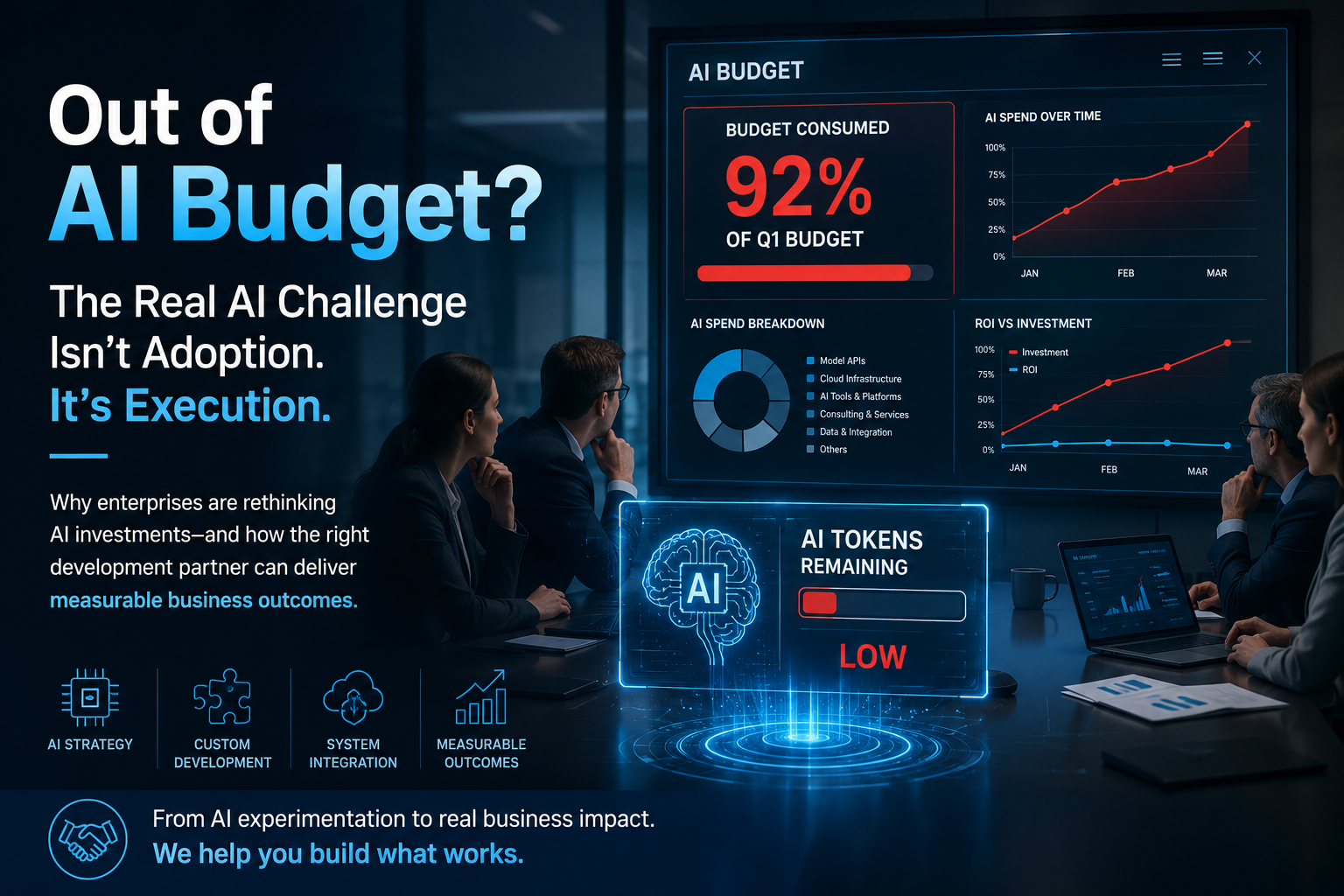
Are You Out of AI Tokens… or Out of AI Budget?
Why Many Enterprises Are Rethinking Their AI Investments—and What Comes Next
Just a year ago, every boardroom conversation seemed to start with the same question:
"What's our AI strategy?"
Today, a different question is emerging:
"What are we actually getting from our AI spend?"
Across industries, enterprises rushed to embrace AI with unprecedented urgency. Budgets were approved. New tools were purchased. Pilot programs were launched. Teams were encouraged to experiment.
But for many organizations, reality has arrived faster than expected.
The first quarter consumed a significant portion of annual AI budgets.
Yet the expected business outcomes haven't materialized at the same pace.
This isn't because AI has failed.
It's because most organizations underestimated the difference between buying AI and building business value with AI.
The Great AI Spending Surge
The last two years have been defined by one thing: speed.
Companies felt pressure from every direction.
Competitors were announcing AI initiatives.
Investors were asking about AI roadmaps.
Customers expected smarter digital experiences.
Leadership teams wanted to avoid being left behind.
The result was a wave of investment in:
- Enterprise AI platforms
- Generative AI subscriptions
- Large Language Model (LLM) access
- AI copilots
- Automation tools
- Intelligent search systems
- Data intelligence platforms
- AI consulting engagements
For many businesses, the assumption was simple:
Deploy AI → Improve productivity → Generate ROI
But enterprise technology rarely follows a straight line.
Why AI Budgets Are Disappearing Faster Than Expected
Most organizations calculate the visible costs of AI.
These include:
- Software licensing
- API consumption
- Cloud infrastructure
- Vendor subscriptions
What often gets overlooked are the implementation costs.
And that's where budgets begin to expand.
Hidden Cost #1: Integration Complexity
AI doesn't operate in isolation.
It needs access to:
- ERP systems
- CRM platforms
- Internal databases
- Legacy applications
- Knowledge repositories
- Customer data systems
Connecting AI to existing business infrastructure is often far more complex than anticipated.
Hidden Cost #2: Data Readiness
Many AI initiatives assume clean, structured, accessible data.
Most enterprises discover something different.
Data lives across departments.
Information is duplicated.
Records are incomplete.
Processes are inconsistent.
Before AI can generate value, organizations often need significant data preparation efforts.
Hidden Cost #3: Security and Compliance
Enterprise AI isn't simply a technology challenge.
It's also a governance challenge.
Organizations must address:
- Data privacy
- Regulatory compliance
- Access controls
- Security frameworks
- Audit requirements
- Model governance
These requirements add time, resources, and cost to every deployment.
Hidden Cost #4: Adoption
Even technically successful AI projects can fail commercially.
Why?
Because employees don't use them.
Technology adoption remains one of the most underestimated components of AI transformation.
Without workflow integration and user adoption, even the most advanced AI systems struggle to generate measurable returns.
The AI Experimentation Trap
Many enterprises currently find themselves stuck in a cycle that looks like this:
Pilot → Excitement → Additional Investment → Limited Adoption → New Pilot
The organization remains active in AI.
Spending continues.
Projects continue.
But business impact remains difficult to measure.
Leadership teams begin asking important questions:
- Which AI initiatives are generating measurable ROI?
- Which projects should scale?
- Which projects should stop?
- How do we move beyond experimentation?
These are healthy questions.
In fact, they signal something important.
The AI market is maturing.
The Shift From AI Hype to AI Accountability
The next phase of enterprise AI will look very different from the last.
The first phase was driven by possibility.
The next phase will be driven by accountability.
Executives no longer want AI demonstrations.
They want outcomes.
They want:
- Faster operations
- Reduced costs
- Improved productivity
- Better customer experiences
- Increased revenue
- Measurable business impact
The conversation is changing from:
"How much AI are we using?"
To:
"What value is AI creating?"
And that's a much more important conversation.
The Real Challenge Isn't AI. It's Execution.
Most enterprises don't suffer from a lack of AI ideas.
They suffer from a lack of execution capacity.
Internal technology teams are already managing:
- Product roadmaps
- Infrastructure modernization
- Security initiatives
- Customer-facing platforms
- Operational systems
Adding AI transformation projects on top of existing responsibilities often stretches teams beyond capacity.
As a result:
Projects slow down.
Timelines expand.
Budgets increase.
Momentum disappears.
The challenge isn't ambition.
The challenge is implementation.
Why Enterprises Need Development Partners, Not More AI Tools
Many organizations believe they have an AI problem.
In reality, they have an execution problem.
They don't need another platform.
They need the ability to transform AI opportunities into production-ready business solutions.
This requires:
Custom AI Development
Building solutions designed around business workflows rather than forcing workflows around generic AI tools.
Enterprise Integration
Connecting AI capabilities with existing systems, databases, applications, and operational processes.
Scalable Architecture
Ensuring AI initiatives can grow beyond pilot programs and support enterprise-scale usage.
Governance and Security
Creating solutions that meet enterprise compliance, privacy, and security requirements.
Long-Term Optimization
Monitoring performance, improving accuracy, and continuously driving ROI.
The Future Belongs to Companies That Build, Not Just Buy
The most successful organizations over the next five years won't necessarily be the ones spending the most on AI.
They'll be the ones implementing AI most effectively.
The winners will focus on:
- Strategic use cases
- Measurable business outcomes
- Operational efficiency
- Intelligent automation
- Scalable implementation
AI is no longer a competitive advantage simply because you have access to it.
Today, everyone has access.
The advantage comes from how effectively you apply it.
Where We Help
At Techrays Labs, we help organizations move beyond AI experimentation and into AI execution.
We partner with enterprises to:
- Build custom AI-powered applications
- Integrate AI into existing business systems
- Modernize legacy platforms
- Develop scalable enterprise software
- Automate complex workflows
- Accelerate digital transformation initiatives
Because the real challenge isn't finding AI tools.
It's turning AI investments into business outcomes.
Final Thoughts
If your organization has already consumed a significant portion of its AI budget but is still searching for measurable ROI, you're not alone.
Many enterprises are discovering that AI success isn't determined by how many tools they purchase.
It's determined by how effectively they implement them.
The next era of AI won't be defined by experimentation.
It will be defined by execution.
And execution is where lasting business value is created.
Looking to turn AI initiatives into production-ready solutions?
Let's discuss how custom software development, AI integration, and enterprise engineering can help you maximize the value of your AI investments.
Contact our team to explore your next AI implementation project.